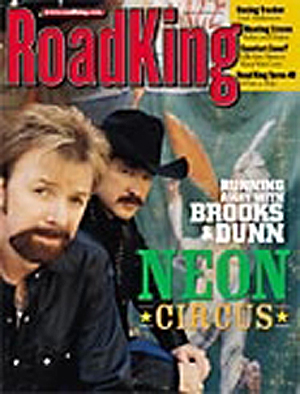
This is the text of an article I wrote about Axel Anderson for Road King Magazine ( a prof truckers journal) about 10 - 11 years ago. It was illustrated with several photos, but the issue, with Brooks & Dunn on the cover, is still packed away from my move. Besides a pretty good overview of Axel's racing years, it tells the story of how the book "Long Ride on a Short Track " came to be.
In It for the Long Haul
By Ken Spooner
For residents of Medford, N.Y., and surrounding areas, the name Axel Anderson means trucking. The 20 or so rigs bearing his name can be spotted making deliveries up and down the East Coast (and occasionally in the Midwest), while his tow trucks are seen untangling Long Island wrecks. But the history of Anderson Trucking, as the 35 employees who work there will tell you, isn't just about trucks. It's also about stock-car racing in fact, the two are pretty much inseparable.
I was 10 years old the first time I saw Axel drive. He had a yellow and black Corvette-powered coupe, an aggressive driving style, and the loudest car on Riverhead (N.Y.) Raceway. I later found out he ran with no exhaust headers at all, using tennis balls to keep out the cool air when he shut the engine down so his valves wouldn't warp. Axel made things interesting.
He had begun driving rigs at 14, setting up carnivals with his pal Vinny Cardamone in 1936. Two years later, Axel had saved up enough to get his first rig, a 1935 Ford tractor with a canvas-colored trailer. Back then, Long Island was primarily an agricultural region, and Axel hauled potatoes and cauliflower from the eastern farms to New York City. He climbed out of his rig to fight in the Pacific campaign during World War II, and when he returned from the war, he climbed back in for another 49 years.
It was immediately following World War II that two very important things happened: Axel married his childhood sweetheart, Ruth, and in 1946 they had a son, Wayne. By 1948, Axel began to acquire more trucks, and that same year he acquired a driver by the name of Joe Forte, who is still with the company today. In 1949, Axel Anderson Trucking (now incorporated) set up operations in Patchogue, N.Y., near the Patchogue River. Axel's natural mechanical ability helped him keep his growing fleet running; it also led to the major repair and modification business that forms a large part of the company today. It was in Patchogue that Axel built several custom trucks, including his locally legendary Ford-White tractor. (An ex-driver of Patchogue Lumber Co. told me of the problems they had had with deliveries until Axel modified their trucks to carry nearly double the loads.)
The trucking business was taking off, but another type of automobile would soon catch his eye. An athlete at heart (he had had aspirations to box in the Olympics), Axel had become interested in stock-car racing. On a bet, he entered a 1949 race at Islip Speedway on Long Island, and his long racing career began.
In the ensuing years, Axel drove his No. 590 1937 Plymouth to track championships at New York's Islip, Freeport and Dexter Park speedways. He also drove midgets and traveled to Cuba in 1952 for a series of races that were thwarted by Castro and his anti-Battista forces when a bomb almost wiped out the delegation of New York and Florida drivers. The races were cancelled, and the drivers caught the next plane home. (Axel and Fidel would cross paths again a few years later, when Castro and his troops hijacked a shipment of Long Island potatoes owned by Axel and John Ambrose, a Riverhead, N.Y., farmer and business partner.
The '50s were times of great changes for Axel and his growing company. Joe Forte left for the Korean War, but before he did he sold Axel his 1940 Ford Coupe for $15 (the reverse gear was blown). Axel gave him a $5 deposit and Joe headed overseas. Upon his return, Axel paid him the balance and Joe quipped, "How about some interest?" Axel replied, "You might be interested to know I had to push the #?&$@# backwards." Joe shot right back, "Last thing on your mind was going backwards with it. You probably made a racecar out of it. How long did it last before you wrecked it?" "I don't recall ... a few weeks," Axel confessed.
Axel wrecked a lot of racecars. Always pushing for the win, he would go through several cars a season, slamming into walls, occasionally crossing the finish line in a shower of sparks, on just three wheels (two newspapers ran a story about that one). He was hard on equipment, and he was hard on his competitors, too. Fights in the pits were commonplace back then, and the entire Anderson pit crew took part in brawls they still talk about today. Axel was a rough-and-tumble stock jockey who didn't go looking for a fight but never walked away from it, and the crowd loved him.
The more Axel raced, the more serious he became about it. He ventured beyond Long Island to bigger tracks like the one in Langhorne, Pa. In 1955, he joined NASCAR and went full-time. He drove down the A1A to Daytona Beach and entered the now-famous Grand National beach race, where he finished 15th after starting 44th not a bad run considering he was a rookie going up against established drivers like Fireball Roberts, Junior Johnson, Curtis Turner and Tim Flock. (After the race, Axel began using the number 15 on his cars.)
Bolstered by his strong showing at Daytona, he entered another NASCAR race at Langhorne that September. On the 115th lap, he blew a tire and crashed hard, upside down, into the wooden guardrail. The rail pierced the driver's compartment, and Axel suffered extensive head injuries. Doctors didn't think he'd survive the first night in the hospital and told Ruth to prepare for the worst. A month later, Axel was back home. Six months later, he returned to race the 1956 season at Long Island.
Within two years, Axel was back in Grand National Stock Cars part-time and entered a '58 Pontiac in the last race held on Daytona's beach/road course. It would be his last year for Grand National (the forerunner of Winston Cup) racing. In 1959 he placed 9th in NASCAR's modified stock car division, driving The Hires Root Beer Special, a 1937 Chevy coupe powered by a 348 Chevy truck engine with eight carburetors and, not surprisingly, famous throughout the New York metropolitan area.
Axel continued racing mostly on weekends throughout the 1960s. But he wasn't the only Anderson who had taken an interest in stock cars. Son Wayne, who had dabbled in racing prior to enlisting in the Air Force in 1965, had been stationed in North Carolina. During a surprise visit, Axel and Ruth discovered their son's dabbling had become a serious passion. If his parents disapproved, Wayne's captain told them, he would order their son to stop racing. The order never came. Upon his discharge from the Air Force, Wayne returned to the family trucking company and a second Anderson racecar was built for the 1969 season.
That year, the Andersons broke ground on the current site of Anderson Trucking on Route 112 in Medford, a few miles north of Patchogue. The bigger site allowed for a much larger repair shop, the addition of new services and an expanded heavy-duty towing and recovery operation. (Axel's recovery philosophy for untangling some of Long Island's most complicated wrecks was simple: "It comes out the way it went in.")Through the 1970s, Axel added to his fleet of over-the-road rigs and expanded his predominantly East Coast routes to include the entire U.S. By the end of the decade, there were some 35 custom-built Anderson rigs crisscrossing the continent.
In 1987, I moved to Nashville to write songs. One night, my thoughts strayed to Axel, and I began writing a song about my childhood memories of him. When it was done, I contacted Anderson Trucking to find out if Axel was still around. Wayne told me his father had just undergone surgery to have a pacemaker installed. I sent Axel a tape, thinking he might get a kick out of it. I thought of Axel again in 1993 while searching for some photos from the early days of Long Island racing. I called Anderson Trucking again, and this time Axel answered. He told me how much the song meant to him, and a long-delayed friendship ensued. The racing stories he told me formed the basis for the book, "Long Ride On A Short Track," which I wrote with help from Axel and his many racing buddies.
In the spring of 1994, Axel developed cancer and was admitted to the hospital for surgery. He was now 71 years old, and though the operation was deemed a success, complications led to an extended hospital stay. Meanwhile, Wayne was in contention to become the first driver from Long Island to capture the NASCAR modified championship. The news helped bolster Axel's spirits. I visited Axel in the hospital in July 1994 and remained in close contact until Sept. 14, when Joe Forte called me with the bad news. Returning for the funeral, I learned from Axel's daughter, Alexis, that the last words he heard were from the song I'd written several years earlier:
Axel drove a stock car,
some 30 years ago.
He didn't always win,
but he always stole the show.
Wore a pack of Luckys
rolled up in his shirt,
Smoked his share of asphalt,
ate his share of dirt.
The funeral services were as memorable as the man himself. The Stray Cat, a Peterbilt recovery wrecker, served as one of the three flower trucks carrying the largest flower order area florists had ever filled. The huge procession made its way past the depot where several rigs and a 1945 Diamond Rio wrecker "15" painted on its side saluted Axel with air horns. When we entered the cemetery, there was some confusion and part of the procession was diverted. Cognizant of what was happening, the driver of the hearse pulled onto the lawn and whipped into a 180-degree turn to get the other drivers' attention. Joe Forte quipped, "It's just like the old man to take one more hot lap!"
A few weeks later, Wayne Anderson became NASCAR's Modified Champion. He drove the No. 15 car.
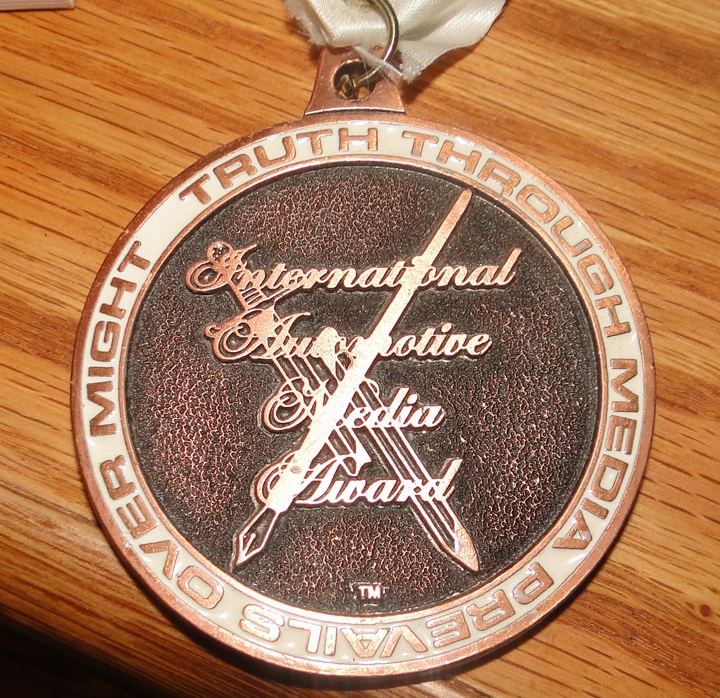
In 2003 I was presented with this medal from the International Automotive Media Assn for the article
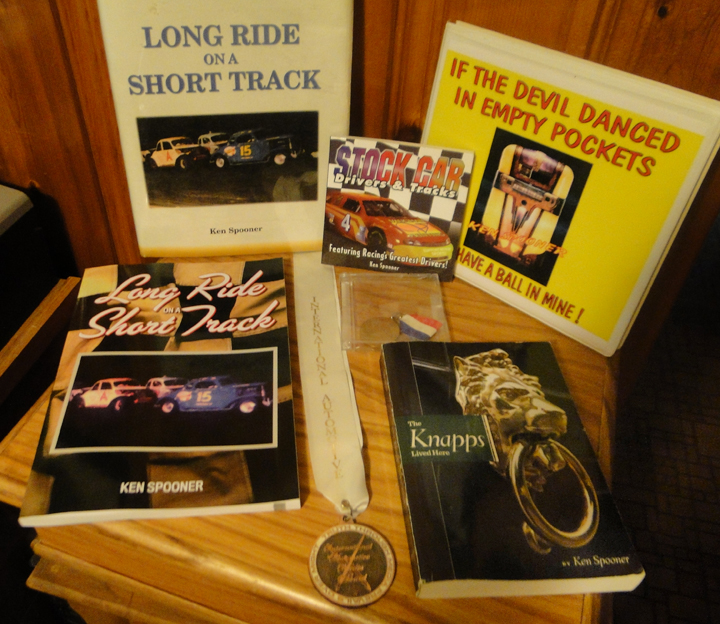
that I keep on display with the books I have written
HOME